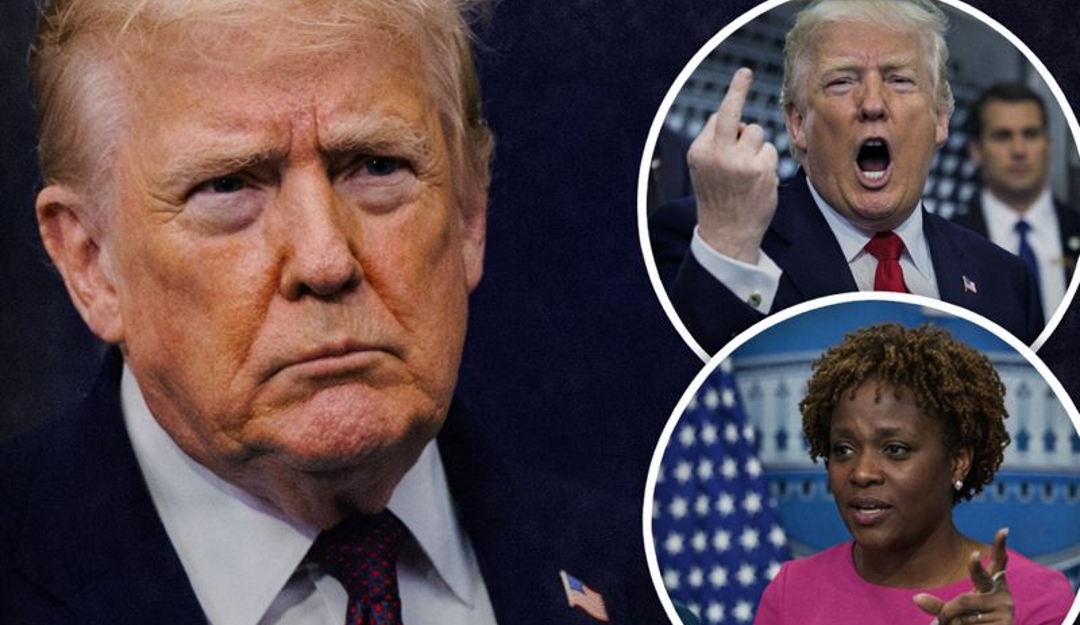
The moment unfolded fast, raw, and on camera. Donald Trump, visibly furious, turned toward a man in the crowd, shouted an explicit insult, and raised his middle finger in response to being accused of protecting pedophiles. Within minutes, the footage spread across social media, igniting outrage, disbelief, and a familiar sense that yet another line had been crossed.
The confrontation reportedly occurred as Trump exited a public appearance, where hecklers were already shouting accusations tied to long-running conspiracy narratives that have followed him for years. One man’s words cut through the noise, prompting Trump to snap. The response was unmistakable — a shouted profanity and a gesture impossible to misinterpret.
What stunned observers wasn’t just the outburst itself, but what came next. When asked about the incident, the White House did not condemn the behavior. Instead, officials described Trump’s reaction as “appropriate,” a word choice that immediately triggered a second wave of backlash.
Critics argued that the response normalized conduct that would be unacceptable for any other public figure. Supporters countered that Trump was merely defending himself against what they called vile and defamatory accusations. The split played out in real time across cable news panels, podcasts, and comment sections, echoing arguments seen in previous political flashpoints involving Trump’s public demeanor.
Video clips of the moment were dissected frame by frame. Some focused on Trump’s facial expression — tight-jawed, visibly enraged. Others zeroed in on the crowd’s reaction, with gasps and shouts audible as the gesture landed. Media analysts compared the scene to past incidents, noting how Trump has repeatedly turned confrontations into viral moments, a strategy examined in earlier breakdowns of his political style.
That moment wasn’t about free speech — it was about power and intimidation, plain and simple. — Political Commentator (@PoliWatch) May 18, 2024
The accusation hurled at Trump — that he protects pedophiles — taps into a darker undercurrent of American politics, where baseless claims and moral panic frequently collide. While no evidence supports the charge, its use reflects how extreme language has become normalized on both sides. Analysts have warned for years that this environment fuels escalation, a concern outlined in long-form reporting on conspiracy culture.
The White House’s response only intensified scrutiny. Press Secretary comments framed Trump’s reaction as understandable given the nature of the accusation, a stance that alarmed ethics experts. Several former officials noted that endorsing such behavior risks lowering standards for presidential conduct even further.
International reaction was swift as well. Foreign media outlets replayed the clip with disbelief, questioning how a former — and potentially future — president could behave in such a manner without official rebuke. The incident was widely covered alongside broader discussions about democratic norms, themes frequently explored in global coverage of US politics.
Trump’s allies, however, framed the moment as authenticity. They argued that voters are tired of polished language and see Trump’s outburst as proof he refuses to be bullied. This narrative has long been central to his appeal, reinforcing the idea that he speaks and acts without filters, regardless of consequence.
If any other politician did this, it would be career-ending. The double standard is staggering. — Civic Accountability Group (@CivicNow) May 18, 2024
Still, legal scholars and former prosecutors warned that normalizing aggressive public behavior from political leaders carries real risks. They pointed to rising threats against public officials and journalists, cautioning that gestures and words from influential figures can embolden volatile individuals.
As the news cycle churned on, the image remained: a former president, finger raised, shouting back at the crowd — and an administration willing to defend it. Whether the moment fades into the endless archive of Trump controversies or becomes a defining symbol of political decay remains to be seen.
For many Americans, though, the question lingers. If this is deemed “appropriate,” what, exactly, is no longer off limits?