
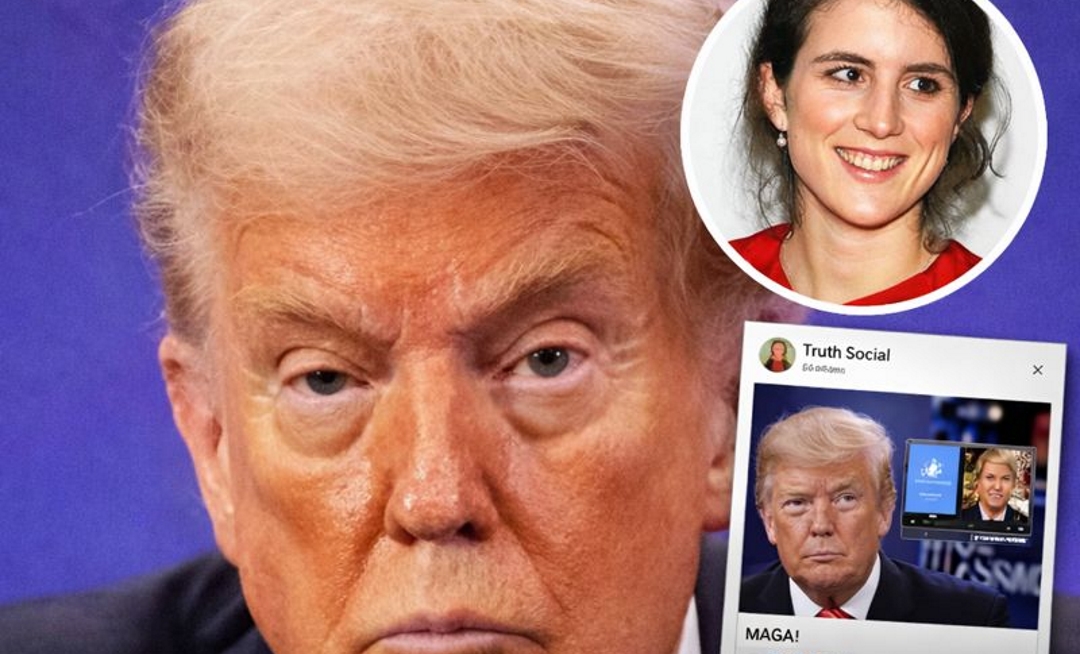
The timing is what ignited the outrage. As news spread that a granddaughter of John F. Kennedy had died, tributes and condolences began quietly filling social feeds. Within hours, however, Donald Trump was posting content that many Americans described as aggressive, tone-deaf, and deliberately inflammatory.
The image circulating online captured the moment perfectly: a hard, unsmiling Trump staring into the camera as critics accused him of hijacking a moment of national mourning to push his own political messaging. The contrast between grief and provocation became impossible to ignore.
The death itself was confirmed earlier that day, with the Kennedy family requesting privacy as they processed the loss. Friends and public figures shared memories, focusing on the young woman’s life rather than politics. But by evening, attention had shifted sharply after Trump’s posts began spreading across Truth Social and beyond.
None of the posts directly mentioned the death. That fact quickly became the core of the controversy. To critics, silence paired with combative messaging felt intentional. To supporters, it was proof that Trump was being unfairly attacked for refusing to perform public grief.
Media analysts pointed to recent political coverage showing how moments of tragedy often expose sharp differences in leadership style. Where some leaders retreat from the spotlight, Trump historically doubles down, keeping his presence loud and unavoidable.
The Kennedy name carries a unique emotional weight in American culture. For many, it symbolizes public service, restraint, and a different political era altogether. That symbolism amplified the backlash, turning what might have been a routine social media flare-up into a broader conversation about decency and timing.
You don’t have to agree politically to know there’s a moment to pause. This wasn’t about policy — it was about respect.— Civic Watch (@CivicWatchUS) December 2025
Supporters were quick to push back. Conservative commentators argued that critics were exploiting a family tragedy to manufacture outrage. They noted that Trump has never followed traditional expectations around public mourning and that demanding silence from him was unrealistic.
Still, even some neutral observers admitted the optics were brutal. In an era where every post is scrutinized, choosing not to acknowledge a high-profile death — while continuing partisan attacks — sends its own message. A recent discussion on media responsibility and power highlighted how silence can be just as loud as speech.
What made the situation worse, critics argued, was the speed. The gap between the death announcement and Trump’s posts was measured in hours, not days. That compressed timeline left little room for interpretation, fueling accusations of callousness.
The Kennedy family has not responded publicly to the controversy. Their silence has only sharpened the contrast. While Trump’s supporters debated intent and free expression, the family remained focused on mourning away from cameras.
This isn’t cancel culture. It’s basic human timing. Read the room.— History & Context (@HistoryContextUS) December 2025
Political strategists say moments like this rarely change Trump’s core base but can matter on the margins. Voters who are exhausted by constant conflict often respond most strongly to perceived lapses in empathy. According to recent voter sentiment analysis, those emotional reactions can linger longer than policy disputes.
Trump himself has not addressed the backlash directly. As with many past controversies, he appears content to let the outrage burn while staying on message. For critics, that refusal to acknowledge the moment is the point. For supporters, it’s proof of consistency.
What remains is an image that many won’t forget — a national family mourning quietly while political noise surged forward without hesitation. Whether history views the moment as trivial outrage or a revealing snapshot of modern leadership may depend on what comes next.