
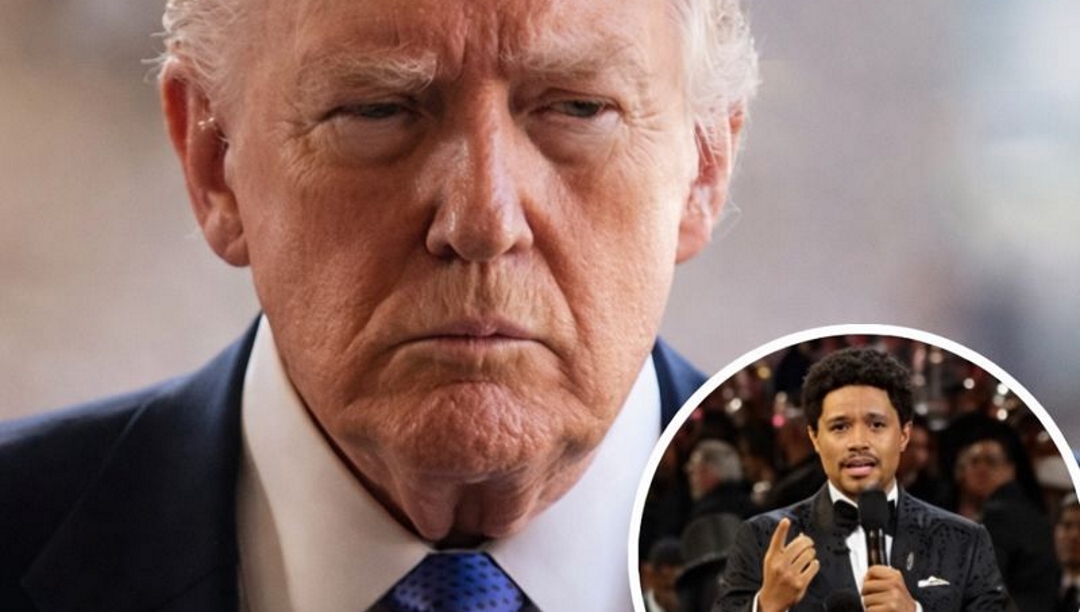
What was supposed to be a quick awards-show punchline turned into a full-blown political meltdown almost instantly. During his hosting duties at the Grammys, Trevor Noah made a joke referencing Jeffrey Epstein — a name that still detonates on contact in American public life. Within hours, Donald Trump was publicly furious.
The joke itself was brief and delivered in the familiar cadence of awards-show satire, touching on Epstein’s notoriety and the long shadow his connections continue to cast over powerful figures. It wasn’t detailed, it wasn’t evidence-based, and it wasn’t framed as a factual accusation. But for Trump, it crossed a line.
Shortly after the broadcast, Trump took to Truth Social to unload. In a rambling post, he attacked Noah personally, calling him “talentless” and claiming the Grammys were “virtually unwatchable.” More strikingly, Trump escalated beyond insults, declaring that he would “send my lawyers” and suggesting legal action was on the table.
The response immediately turned a fleeting comedy moment into a national headline. What might have otherwise been forgotten by the next morning became a political flashpoint — not because of what Noah said onstage, but because of how aggressively Trump reacted to it.
Trump’s post framed the joke as defamatory, implying it falsely associated him with Epstein. Yet the line Noah delivered never singled Trump out by name, nor did it accuse him of criminal conduct. It operated in the same murky cultural shorthand that has dominated Epstein-related commentary for years — where implication, proximity, and notoriety are blurred into a single loaded reference.
Legal experts have long noted that defamation cases stemming from satire are extraordinarily difficult to win, particularly for public figures. Courts typically examine whether a reasonable viewer would interpret the statement as a literal assertion of fact. In the context of a televised comedy monologue at an awards show, that bar is extremely high.
That hasn’t stopped Trump from threatening legal action against comedians, journalists, and media outlets before. Lawsuits — or the threat of them — have become a recurring tactic, often serving as a public relations weapon rather than a courtroom strategy. Even when cases go nowhere, the announcement itself dominates news cycles.
This episode also taps into a much larger cultural tension. Epstein’s crimes, death, and the subsequent release of documents have created an environment where any mention of his name triggers outrage, suspicion, and conspiracy almost automatically. Public figures referenced in that orbit often react defensively, aware that online narratives can spiral far beyond the original claim.
In Trump’s case, the sensitivity is amplified by his history with media scrutiny and his longstanding hostility toward entertainers who criticize him. A joke from a high-profile stage — especially one watched by millions — is treated not as entertainment, but as a political attack.
The irony is that Trump’s reaction likely gave the joke far more reach than it ever would have had on its own. Clips of Noah’s line circulated widely only after Trump’s post began trending. Headlines focused less on the content of the joke and more on Trump’s fury and legal threats.
Entertainment analysts pointed out that awards-show hosts have been making risky jokes about politicians for decades, often pushing boundaries precisely because the format allows it. What’s different now is the speed and intensity of backlash — and the willingness of public figures to frame comedy as legal warfare.
So far, there is no indication that any lawsuit has actually been filed. No court documents have surfaced, and Trump’s threat remains confined to social media. Still, the incident highlights how quickly satire, scandal, and power collide in the modern media landscape.
What remains clear is that the Epstein name continues to function like a live wire. Even a passing reference — stripped of specifics and delivered as humor — is enough to provoke explosive responses from some of the most powerful people in the country.
Whether Trump follows through on his threat or not, the moment has already served its purpose in the attention economy. A joke became a controversy, a controversy became a political statement, and the cycle fed itself once again.
In the end, the Grammys weren’t remembered for the music that night. They were remembered for a line, a reaction, and a reminder that in today’s culture, comedy can trigger consequences far beyond the stage.
Coverage of Trump’s response and the broader reaction to the joke was detailed by Vanity Fair’s report on the Truth Social outburst, while entertainment media later contextualized the moment within the Grammys broadcast itself in a breakdown of the onstage exchange and its fallout.