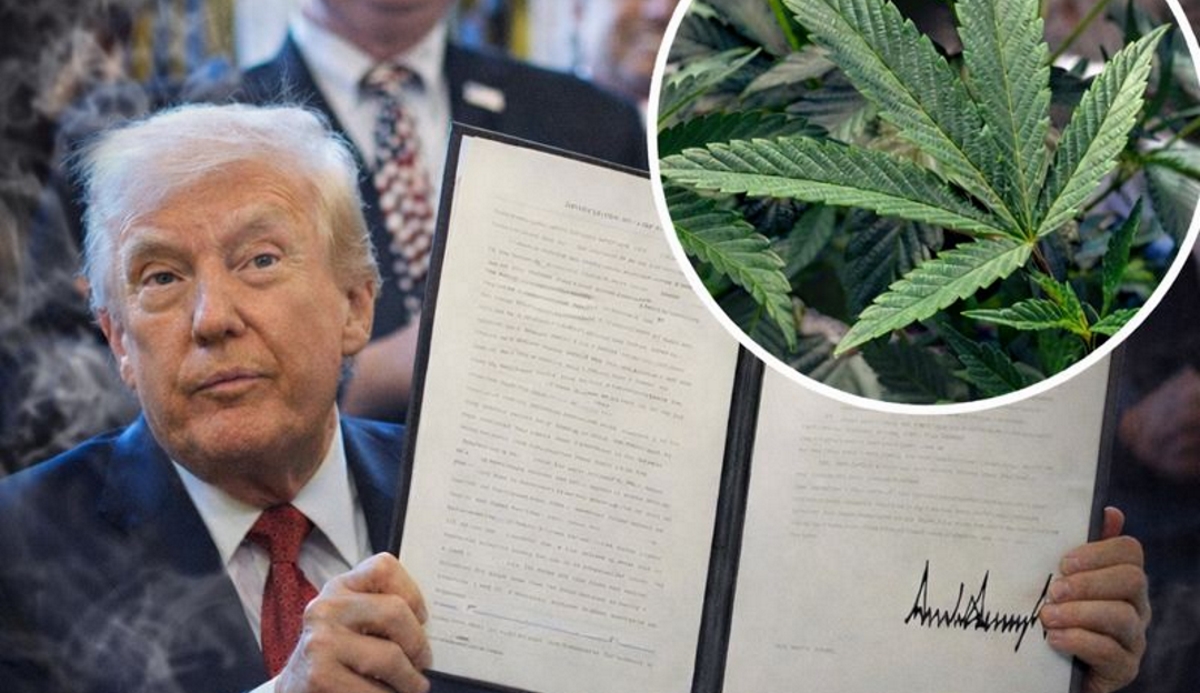
Donald Trump has signaled a major shift in his stance on marijuana, catching both supporters and critics off guard and reopening a debate that has long divided conservatives, libertarians, and criminal justice reform advocates. The remarks, delivered casually but clearly, marked one of the most notable departures yet from traditional Republican orthodoxy on drug policy.
For years, Trump largely avoided staking out a firm position on marijuana, deferring to states while keeping distance from federal reform efforts. That ambiguity now appears to be cracking. In recent comments, he suggested openness to broader reform, framing the issue less as a moral question and more as one of fairness, enforcement, and economic reality.
Emphasized that current marijuana laws have produced uneven outcomes, with ordinary people facing serious consequences while legal markets flourish in some states. The tone was pragmatic rather than ideological, a shift that did not go unnoticed among longtime observers.
The comments immediately reignited discussion about federal marijuana scheduling, sentencing reform, and states’ rights. Analysts noted that Trump’s language echoed concerns raised in old policy debates about how conflicting laws undermine trust in the system.
Supporters of reform seized on the moment, arguing that Trump’s shift reflects political reality. Marijuana legalization now enjoys majority support across party lines, and legal cannabis is a multibillion-dollar industry employing hundreds of thousands of Americans. Ignoring that landscape, they argue, is no longer viable.
Within conservative circles, reaction was mixed. Some praised the move as overdue realism, pointing out that enforcement has often fallen hardest on low-level offenders while failing to curb use. Others warned that softening on marijuana risks alienating social conservatives who view drug liberalization as cultural decline.
Marijuana reform isn’t left or right anymore — it’s reality. — Policy commentator (@PolicyShift) Dec 2025
What makes the shift significant is Trump’s influence over the Republican base. Few figures can move opinion within the party as decisively. If he continues down this path, it could accelerate internal realignment similar to what happened with criminal justice reform during his first term.
Critics caution that rhetoric alone does not equal policy. Trump did not outline specific legislative proposals, leaving open questions about whether he supports rescheduling marijuana, expunging convictions, or protecting state-legal markets from federal interference. Those details matter, as explained in breakdowns people often skip when headlines dominate.
Still, the symbolism carries weight. For decades, Republican leaders framed marijuana primarily as a public safety threat. Trump’s language reframed it as a governance issue — a subtle but important shift that aligns with changing public attitudes.
Some allies say the move reflects lessons learned from Trump’s earlier criminal justice reforms, where bipartisan cooperation delivered tangible results. Others see electoral calculation, noting that younger voters overwhelmingly support legalization and are increasingly influential.
This is what adapting to voters actually looks like. — Political strategist (@ElectoralMath) Dec 2025
Opponents argue the shift risks trivializing concerns about addiction and mental health. They warn that commercialized cannabis markets have introduced their own problems, including high-potency products and aggressive marketing. Those concerns are detailed in arguments conservatives still cite in opposition to reform.
Trump’s remarks did not dismiss those risks outright, but they suggested that prohibition has failed to address them. Instead, he implied that regulation may offer better control than criminalization — a position once considered fringe within GOP politics.
The business community also took notice. Cannabis stocks saw brief movement following the comments, reflecting how closely investors watch federal signals. Industry leaders argue that clarity, even incremental, could unlock banking access and stabilize markets. That economic angle is explored in financial coverage that rarely intersects politics.
Whether Trump’s shift evolves into concrete policy remains uncertain. He has a history of testing ideas publicly before committing, leaving room for recalibration. But even tentative openness represents a meaningful departure from past messaging.
For reform advocates, the moment feels consequential. They argue that when a figure as polarizing and influential as Trump acknowledges the limits of existing law, the conversation changes — even without immediate legislation.
For conservatives wary of cultural change, the shift raises uncomfortable questions about where the party draws its lines. Is marijuana still a moral issue, or has it become another example of policy lagging behind reality?
As the debate unfolds, one thing is clear: Trump’s comments have broken a long-standing silence. In doing so, they’ve forced a reckoning within a movement that can no longer avoid the issue.
Whether this marks a genuine transformation or a tactical adjustment will become clearer with time. But the signal has been sent — and the political landscape around marijuana may never look the same.