
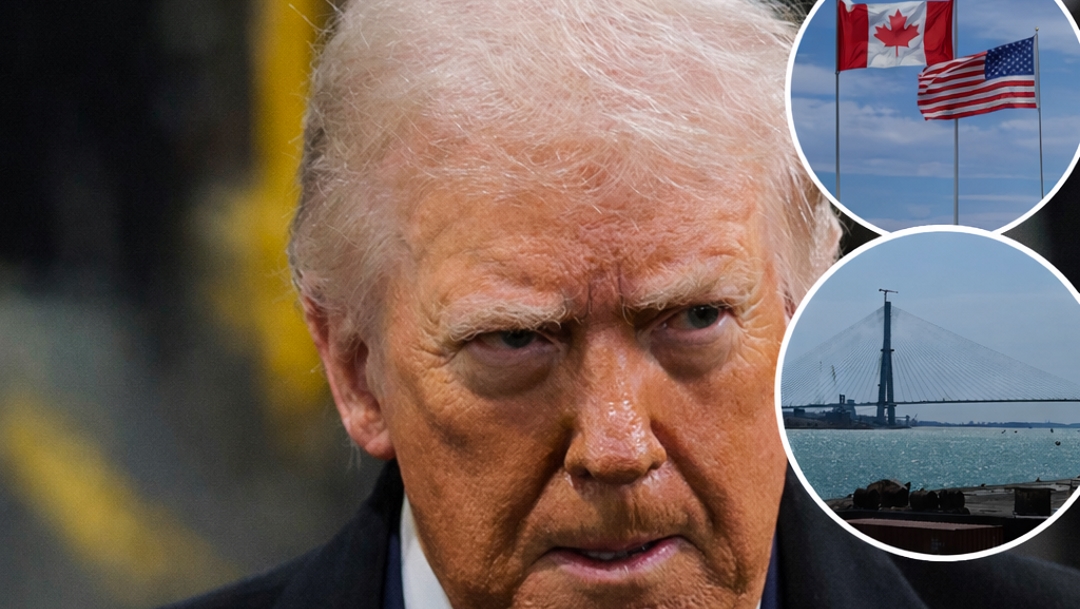
Former President Donald Trump has warned that he would move to block the opening of a $4.7 billion bridge connecting the United States and Canada unless what he calls a “major change” is made to existing cross-border arrangements.
The project in question is the Gordie Howe International Bridge, a long-anticipated infrastructure development linking Detroit, Michigan, to Windsor, Ontario. Years in the making, the bridge has been promoted as a critical trade corridor expected to ease congestion and modernize one of North America’s busiest commercial crossings.
In recent remarks, Trump criticized aspects of the agreement governing the bridge’s operations, arguing that the current structure disadvantages American interests. He did not outline specific legal steps but suggested that future federal action could delay or prevent the bridge from opening under its present terms.
The Gordie Howe International Bridge has been described by transportation officials as a once-in-a-generation investment in cross-border infrastructure. According to project updates published by the official bridge authority website, construction has progressed steadily, with major structural components nearing completion.
The bridge is intended to complement the Ambassador Bridge, a privately owned crossing that has long handled a substantial share of U.S.-Canada trade. Government officials in both countries have argued that the new span will increase capacity, improve security coordination, and strengthen economic ties.
Trump’s warning has introduced fresh uncertainty into a project that has already navigated years of political and legal debate. Supporters of the bridge say it represents a strategic investment in supply chains, particularly in the automotive and manufacturing sectors that rely heavily on cross-border shipments.
Critics aligned with Trump contend that certain operational agreements, including inspection procedures and revenue structures, should be revisited. They argue that border infrastructure must reflect broader national priorities, particularly regarding trade enforcement and security.
Canadian officials have largely maintained that the bridge was negotiated through a bilateral framework and financed under arrangements agreed upon years ago. Public statements from Ottawa have emphasized that the project remains on track and is expected to deliver long-term economic benefits.
Business groups on both sides of the border have expressed concern that any delay could disrupt planning and investment decisions. The Detroit-Windsor corridor is one of the most vital trade arteries in North America, with billions of dollars in goods crossing daily.
According to background information from the U.S. Department of Transportation, cross-border infrastructure plays a key role in maintaining supply chain resilience, especially in industries that depend on just-in-time delivery systems.
Local leaders in Michigan have underscored the economic stakes. They point to projected job creation during construction and long-term commercial growth once the bridge becomes fully operational. Windsor officials have echoed similar expectations, framing the project as a symbol of enduring cooperation between the two countries.
Political analysts note that Trump’s statement fits within a broader pattern of hardline rhetoric on trade and border policy. During his presidency, he frequently called for renegotiations of international agreements and leveraged infrastructure discussions as part of larger policy debates.
However, experts caution that blocking or delaying an international infrastructure project would involve complex legal and diplomatic considerations. The bridge is governed by binational agreements, and significant changes could require coordination between federal authorities in both Washington and Ottawa.
Transportation planners emphasize that the project has already secured extensive regulatory approvals. Construction milestones have been publicly documented, and the bridge’s opening has been anticipated as a major event in regional economic development.
While Trump’s remarks have sparked headlines, no immediate procedural steps have been announced to halt the project. Observers say the coming months will determine whether the warning translates into formal action or remains a political statement.
For now, work on the bridge continues. Engineers and contractors remain focused on completing the remaining phases of construction, as businesses and commuters look ahead to a new chapter in cross-border travel and trade.
The debate highlights the intersection of infrastructure, politics, and international cooperation. As discussions unfold, the future of the $4.7 billion bridge may hinge not only on engineering timelines but also on evolving policy priorities.