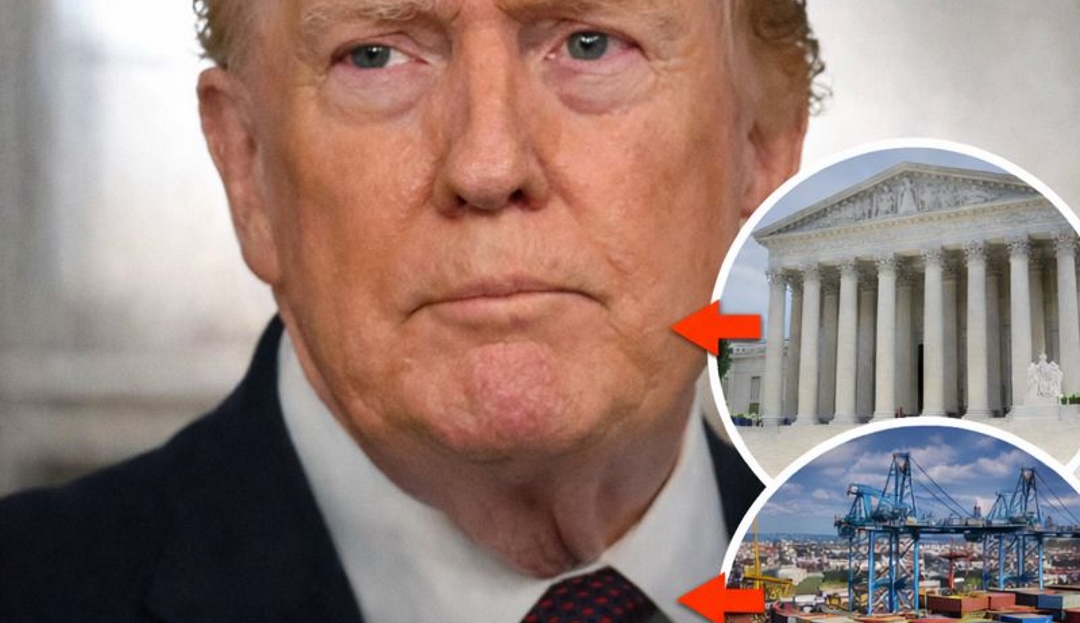
The image is stark and deliberate. Donald Trump staring straight ahead, jaw set, flanked by symbols of power and pressure — the Supreme Court on one side, global shipping containers on the other. It’s not subtle, and neither is the message behind it.
In recent remarks, Trump has warned that the United States could face “serious consequences” if the Supreme Court moves to block his proposed tariff strategy, a plan that would dramatically reshape trade relationships and revive some of the most aggressive economic policies of his presidency.
The warning landed hard because it wasn’t framed as a political complaint. It was framed as an economic threat. Trump’s allies say the tariffs are designed to protect American manufacturing, punish foreign competitors, and reset what they call decades of lopsided trade deals — ideas that echo longstanding debates over tariff power that have divided economists for generations.
But this time, the battlefield isn’t Congress or the campaign trail. It’s the Supreme Court.
Legal experts say the heart of the issue lies in whether a president can unilaterally impose sweeping tariffs under existing national security and trade statutes. Critics argue the plan stretches executive authority beyond its limits, while supporters insist the law already grants that power — a dispute similar to past clashes over executive trade authority.
Trump’s warning suggests he sees a judicial rejection not just as a legal loss, but as a destabilizing event. According to people close to him, he believes striking down the tariffs would weaken U.S. leverage globally, embolden rivals, and send markets into uncertainty.
That uncertainty is already rippling. Trade analysts note that shipping firms, manufacturers, and financial markets are watching closely, especially sectors tied to ports, imports, and supply chains — the same areas highlighted in recent warnings about supply chain fragility.
Behind the scenes, Trump’s rhetoric has raised alarms among legal scholars who worry about the implication that court rulings themselves could trigger economic fallout. One constitutional law professor described the tone as “extraordinary,” saying it blurs the line between policy disagreement and pressure on the judiciary.
Supporters, however, see it differently. They argue Trump is simply stating reality — that overturning the tariff plan could disrupt negotiations already underway and undermine confidence among domestic producers who have bet on protectionist policies.
Trump isn’t bluffing. Tariffs are central to his entire economic worldview — if courts block them, it reshapes everything. — TradePolicyWatch (@TradePolicyWatch) January 2026
The Supreme Court has not indicated how it might rule, and justices typically avoid signaling decisions in advance. Still, the mere possibility of intervention has reignited debate over how much economic power should rest in one branch of government — a question explored in the long history of checks and balances.
What makes this moment especially volatile is timing. Global trade tensions remain high, domestic inflation anxieties persist, and election-year politics amplify every statement. Trump’s language appears designed not only to influence legal interpretation but to rally supporters around a narrative of judicial obstruction.
Business leaders are split. Some manufacturing groups quietly support the tariffs, seeing them as leverage against cheaper imports. Others fear retaliation, price spikes, and trade wars that could hit consumers and exporters alike — risks outlined in recent economic outlooks.
For Trump, the issue cuts deeper than economics. Tariffs have become symbolic — proof of strength, independence, and willingness to challenge global norms. A Supreme Court rejection would be more than a policy setback; it would strike at the core of his governing philosophy.
This is a rare moment where courts, markets, and politics collide — and everyone knows the stakes are massive. — LegalEconomics (@LegalEconNow) January 2026
As the legal process unfolds, the warning hangs in the air. Whether interpreted as strategy, pressure, or genuine concern, Trump’s message is clear: in his view, stopping the tariff plan would not simply end a policy — it would trigger consequences the country may not be ready for.