
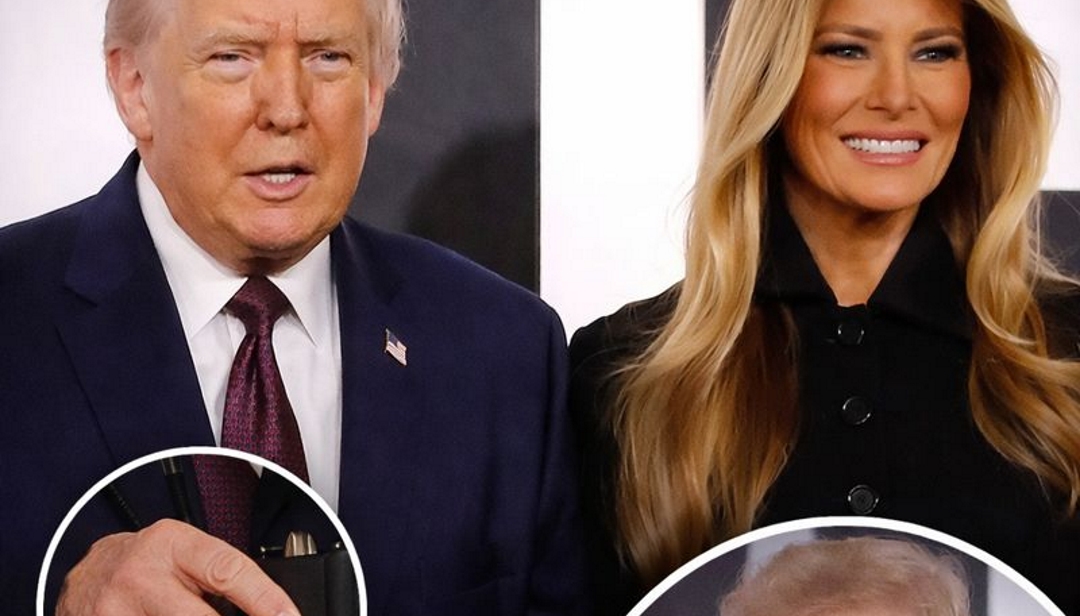
It was supposed to be Melania Trump’s night, the kind of carefully framed, photo-ready event where every smile is practiced and every handshake is timed. The premiere for her new documentary had the typical trappings—flashbulbs, polite questions, a sea of suits—and then the cameras drifted to the person standing beside her, and the entire mood shifted.
President Donald Trump showed up to support his wife at the Washington premiere of “Melania: Twenty Days to History,” and in the clips that quickly spread online, viewers fixated on something they claimed looked unsettling. While Melania spoke to interviewers, Trump stood nearby and appeared to sway slightly, closing his eyes at moments as if fighting off fatigue or zoning out.
The internet did what it always does: slowed the footage down, replayed it, froze it at the least flattering frames, and filled the silence with theories. People weren’t just commenting on the optics of a public appearance—they were turning it into a referendum on the president’s stamina, and the commentary quickly took on a sharper edge than the usual political sniping.
On X, critics and casual observers alike piled in with sarcastic posts about him looking “thrilled” to be there, and others suggested he was struggling to stay awake. Some framed it as exhaustion. Others framed it as something darker. And in the way these moments now unfold, the speculation became part of the story almost instantly, with the clip circulating faster than any official recap of what the documentary actually says.
The premiere itself was staged at the Trump–Kennedy Center, in an atmosphere meant to sell polish and momentum. Melania was positioned as the focus—composed, controlled, speaking about the film and its production—while Trump stood close enough to project unity without stealing the microphone. But in the short windows where he wasn’t speaking, body language became the loudest thing happening on camera.
That’s what made the reaction so intense: it wasn’t a gaffe, it wasn’t a misquote, it wasn’t a policy fight. It was a handful of seconds where he looked physically “off” to some viewers, and that’s enough in a climate where every blink, bruise, stumble, or pause is treated like a potential clue to something bigger.
This isn’t the first time Trump’s appearance has triggered a wave of viral concern. Over the past year, online chatter has repeatedly spiked over visible marks on his hand, moments where he seemed to drift during long events, or clips that critics insist show slurred words or a slowed cadence. In each case, the administration has pushed back hard, characterizing the talk as conspiracy-brained nonsense fueled by political hatred.
In this latest round, the White House line was blunt: Trump is fine, he’s energetic, he’s working, and the obsession over small visual moments is being treated as bad-faith noise. A spokesperson dismissed the speculation as “deranged conspiracy theories,” insisting the president is in “perfect health” and portraying the online frenzy as a manufactured smear campaign rather than a legitimate question.
But the problem with visual moments is that they don’t need to be true to feel persuasive to people who already believe them. The camera doesn’t explain itself. The clip doesn’t come with context. And once a certain interpretation takes hold—“he’s tired,” “he’s unwell,” “he’s fading”—it spreads like smoke because it fits into an existing narrative that millions of people are already primed to argue about.
At the same time, supporters argue the opposite: that his opponents are so desperate for a storyline that they’ll turn a blink into a diagnosis, and that no president in modern politics has been more relentlessly scrutinized for normal human aging. They point out that long public days, bright lights, and endless stop-and-start interviews can make anyone look strange in cherry-picked clips.
The documentary itself has only added fuel to the wider conversation because it’s a political object as much as a film. Reviews have been rough, with critics describing it as propaganda dressed up as behind-the-scenes access, and its early reception has been dominated by arguments about intent rather than artistry. On its early critical score critics described it as offering little new insight, while some fans praised it as a flattering glimpse of a first lady they believe is unfairly misunderstood.
That split reception matters because it sets the emotional temperature of the night. If you believe the film is a glossy narrative project, then Trump standing there with his eyes closing becomes symbolic—like the image of a presidency exhausted by its own performance. If you believe the film is a legitimate portrait and the critics are hostile, then the viral clip feels like another example of opponents grasping for anything they can twist.
Either way, the moment has been absorbed into a larger churn of online “health-watch” content that surrounds Trump constantly. It’s not driven by official medical findings—it’s driven by optics, rumor, and the modern habit of treating public figures like puzzles the internet is determined to solve in real time.
And because it happened at an event meant to spotlight Melania, it also created an uncomfortable contrast: her speaking, poised and measured, while the attention slipped away toward the man beside her and what people thought they saw in his posture. That’s the cruel part of these viral narratives—someone else can be doing the talking, but a fleeting facial expression can hijack the entire evening.
If you want to see how the story was framed and what the White House said in response, UNILAD’s report is here in full, and the clip that sparked the chatter is circulating across social platforms alongside a flood of commentary.
For now, what’s actually “true” about the moment depends on what you’re willing to infer from a few seconds of video. What’s undeniable is the effect: a premiere designed to promote a documentary became another flashpoint in the endless fight over Trump’s health, his public image, and the way the internet turns ordinary human behavior into a political Rorschach test.