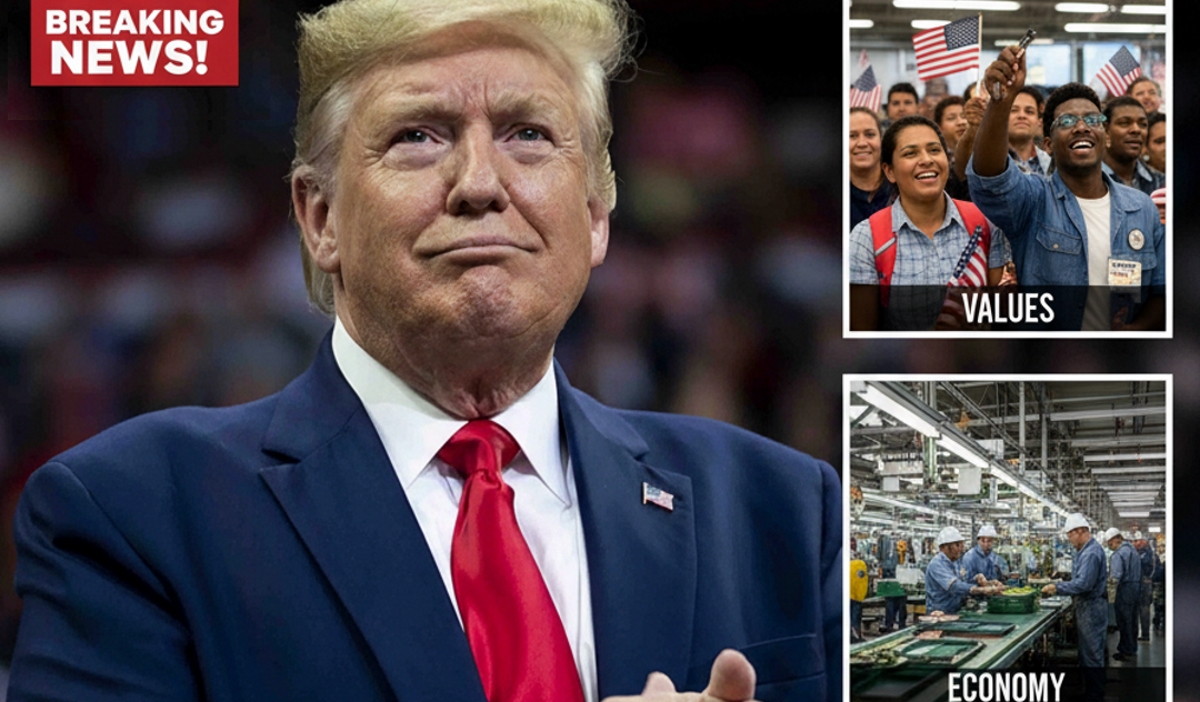
Donald Trump’s words were unmistakably blunt. “If you don’t share our values, contribute to our economy, and assimilate into our society — then we don’t want you,” the former president declared, a statement that immediately cut to the core of one of America’s oldest and most unresolved arguments.
Within minutes, the quote spread across political media, reigniting a debate that has shaped elections, immigration law, and national identity for generations. Supporters framed it as overdue clarity, while critics warned it signaled a narrowing vision of who gets to call the United States home.
Trump’s message arrived amid rising public anxiety over border crossings, labor pressures, and cultural change. Polling cited in recent surveys shows immigration once again ranking among voters’ top concerns, especially as trust in federal enforcement continues to erode.
At the center of the controversy is the word “assimilate,” a term loaded with historical baggage. Scholars note that assimilation has meant very different things across eras, from language and civic participation to cultural conformity, distinctions explored in historical analysis tracing how the concept has evolved.
Assimilation shouldn’t mean erasing who you are. America has always been plural. — Rep. Pramila Jayapal (@RepJayapal) Dec 2025
Trump allies argue the statement reflects mainstream expectations shared by legal immigrants who followed established pathways. Conservative voices circulated data highlighted in economic reviews showing strong support for requirements tied to work, law-abiding behavior, and civic participation.
They contend the real controversy is not exclusion, but standards. In their view, Trump articulated what many voters feel but politicians avoid saying aloud: that national cohesion depends on shared rules and responsibilities.
Opponents counter that the framing risks painting immigrants as perpetual outsiders, regardless of contribution. Civil rights advocates pointed to research summarized in rights briefings warning that rhetoric linking belonging to cultural conformity has historically fueled discrimination.
The economic argument embedded in Trump’s quote also drew scrutiny. Economists have repeatedly found that immigrants, including undocumented ones, are net contributors over time, a conclusion supported by long-term modeling examining taxes, labor, and growth.
Immigrants already contribute — in labor, taxes, and communities. This erases that reality. — Heidi Shierholz (@hshierholz) Dec 2025
Yet Trump’s framing resonates powerfully with voters who feel cultural change has accelerated faster than institutions can manage. Analysts studying populist movements note that identity-based language often outperforms policy detail, a dynamic unpacked in messaging studies focused on modern campaigns.
Immigration historians note that similar language has surfaced repeatedly during periods of economic stress and demographic shift. From the Chinese Exclusion Act to post-9/11 security laws, moments of fear have often narrowed definitions of belonging, patterns outlined in archival timelines documenting past crackdowns.
Trump’s critics argue the danger lies in who decides what “our values” actually are. Without clear definition, they warn, such standards can be applied selectively, concerns raised in legal commentary examining constitutional limits.
Supporters respond that values are already embedded in law, pointing to requirements around English proficiency, civics exams, and oaths of allegiance. They argue Trump’s statement merely restates expectations already present in the naturalization process, arguments echoed in process outlines explaining citizenship requirements.
Every country has the right to expect newcomers to integrate. That’s not radical. — Sen. Josh Hawley (@HawleyMO) Dec 2025
The reaction within immigrant communities has been deeply mixed. Some first-generation Americans expressed agreement with the emphasis on contribution, while others described feeling targeted despite decades of work and civic engagement, experiences captured in community interviews reflecting that divide.
Faith leaders also weighed in, noting that assimilation rhetoric often collides with moral obligations to protect the vulnerable. Statements from religious coalitions referenced principles detailed in ethical guidance emphasizing dignity regardless of origin.
Politically, the quote has already become a rallying cry. Campaign strategists say it sharpens contrasts ahead of the election, forcing opponents to respond to a moral framing rather than policy minutiae, a tactic examined in strategy breakdowns tracking Trump’s approach.
This line will define the immigration debate for the rest of the campaign. — Alex Burns (@alexanderburns) Dec 2025
What remains unresolved is whether Trump’s statement clarifies expectations or hardens divisions. Legal experts note that immigration law already balances inclusion with enforcement, but rhetoric can tilt public perception faster than statutes ever could, a warning highlighted in governance research.
For many Americans, the debate triggered by Trump’s words is less about borders than belonging. It asks whether national identity is defined by shared rules, shared culture, or shared commitment to pluralism, a question the country has answered differently across eras.
As the campaign moves forward, the line is likely to be repeated, dissected, and weaponized. Whether embraced as common sense or condemned as exclusionary, it has already succeeded in one respect: forcing the nation to confront, once again, who it believes deserves to be included in the American “we.”