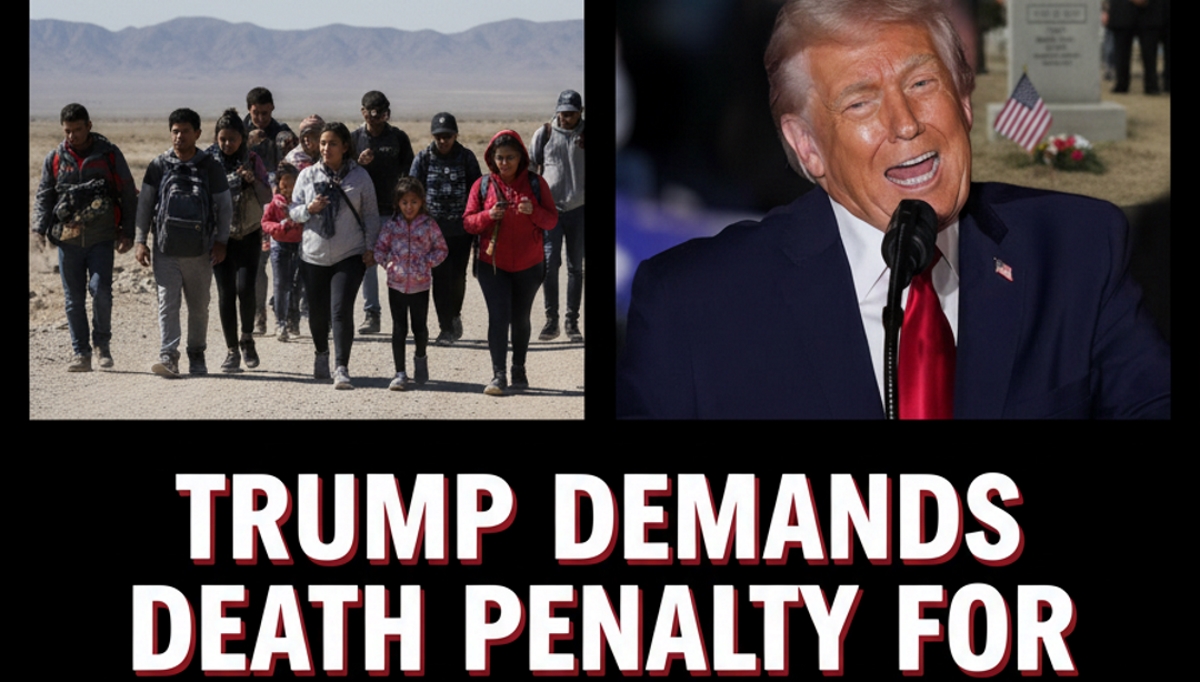
The sentence hit like a blunt-force shock to an already fractured national conversation. “I’m hereby calling for the death penalty for any migrant that kills an American citizen or a law enforcement officer,” Donald Trump declared, a line that spread across screens within minutes and instantly reframed the immigration debate around punishment, fear, and retribution.
Within hours, the statement was replayed on cable news, dissected by legal scholars, and amplified across social platforms where reactions hardened into camps. Supporters described it as overdue toughness, while critics warned it crossed a moral and constitutional line that cannot be uncrossed once normalized.
The remark surfaced as immigration remains one of the most volatile issues in the 2024 political cycle, with border crossings, asylum backlogs, and high-profile crimes dominating headlines. Trump’s framing, according to legal context circulating among scholars, deliberately fused immigration enforcement with capital punishment in a way no modern president has explicitly proposed.
Criminal law experts immediately pointed out that the federal death penalty already exists for certain crimes, regardless of immigration status. What made Trump’s statement explosive, analysts noted in policy breakdowns, was the suggestion of a separate standard based solely on who the defendant is rather than what crime was committed.
This isn’t about justice. It’s about creating a separate class of people under the law. — Rep. Joaquin Castro (@JoaquinCastrotx) Dec 2025
Supporters of Trump’s proposal argue the distinction is justified by sovereignty and deterrence. Conservative commentators framed the statement as a response to what they describe as preventable deaths, echoing arguments outlined in border-security commentary that links violent crime to enforcement failures.
Yet decades of criminology research challenge the deterrence claim. Multiple studies summarized in empirical reviews have found no credible evidence that capital punishment reduces homicide rates, a point critics seized on as the debate intensified.
The legal obstacles are substantial. Constitutional scholars note that applying different punishments based on immigration status would almost certainly trigger equal protection challenges, concerns raised repeatedly in constitutional analysis shared widely after Trump’s remarks.
Trump’s allies counter that immigration law has always treated non-citizens differently, citing deportation, detention, and asylum restrictions as precedents. They argue that violent crime changes the calculus entirely, a stance defended in ideological essays circulating among right-leaning legal circles.
Americans are tired of leaders putting criminals ahead of victims. This is about accountability. — Tom Fitton (@TomFitton) Dec 2025
Civil rights groups responded with alarm, warning that such rhetoric risks fueling vigilante violence and dehumanization. Advocates referenced past spikes in hate crimes following inflammatory political statements, patterns documented in longitudinal tracking of extremist activity.
Families of crime victims found themselves pulled into the crossfire. Some relatives publicly supported harsher penalties, while others rejected the idea of using their loved ones’ deaths to justify sweeping policies, sentiments captured in victim-centered reporting that complicates the narrative.
The immigration status of violent offenders has long been a political flashpoint, but data often tells a less sensational story. Large-scale analyses summarized in crime statistics reviews consistently show immigrants, including undocumented ones, commit violent crime at lower rates than native-born citizens.
Trump’s rhetoric nonetheless resonates with voters who feel abandoned by institutions they believe prioritize process over safety. Polling trends referenced in opinion surveys show rising support for extreme enforcement measures even as trust in the justice system erodes.
When leaders talk about death so casually, it tells you how broken our politics has become. — Sherrilyn Ifill (@Sifill_LDF) Dec 2025
International law experts also weighed in, noting that singling out migrants for execution could violate treaty obligations the United States has long championed. Those concerns were outlined in human rights assessments shared by global advocacy groups.
Trump’s history of testing legal boundaries looms over the controversy. From calls to ban Muslim immigrants to family separations at the border, critics argue the death penalty statement fits a broader pattern examined in chronological breakdowns of his immigration agenda.
Republican leaders offered mixed reactions. Some echoed Trump’s language almost verbatim, while others attempted to soften it by emphasizing existing penalties rather than new ones, distinctions highlighted in intra-party coverage tracking the split.
Legal analysts caution that even proposing such measures reshapes expectations. Once extreme punishment enters mainstream discourse, scholars warn in governance studies, the boundary of what seems acceptable can shift rapidly.
This is how you normalize the unthinkable — one sentence at a time. — Michelle Goldberg (@michelleinbk) Dec 2025
As the statement continues to reverberate, its practical impact remains uncertain. No legislation currently reflects Trump’s proposal, but the political signal is unmistakable, and its echoes are already shaping campaign rhetoric, media framing, and public fear.
What began as a single declaration has reopened fundamental questions about equality before the law, the purpose of punishment, and the power of language when spoken by those seeking the highest office. Whether embraced or condemned, the remark has forced the country to confront how far it is willing to go in the name of security.