
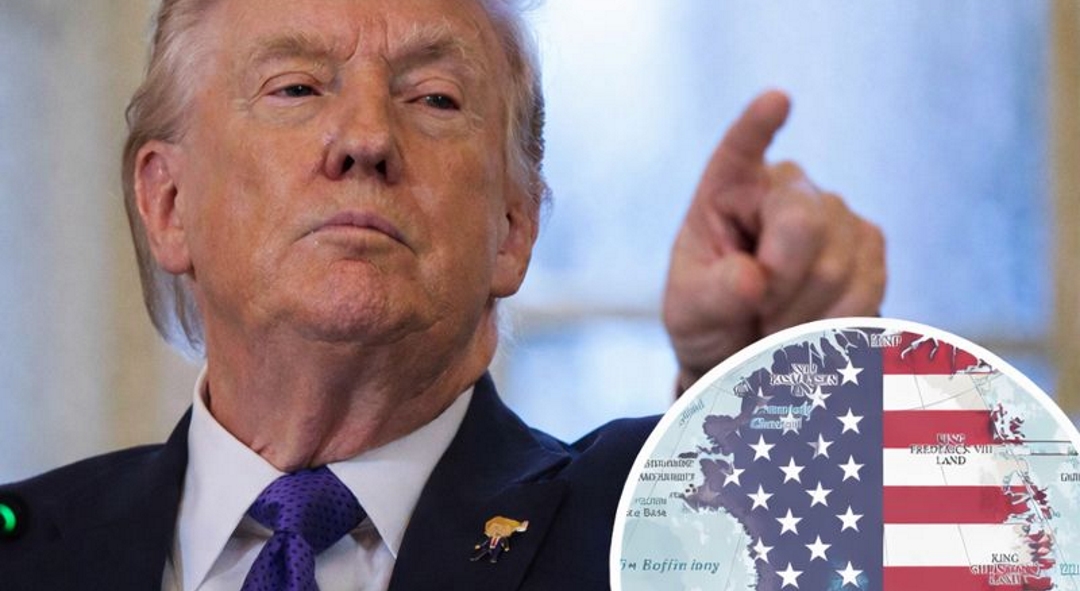
The image spread fast, and it didn’t need much explanation. Donald Trump, arm raised, eyes fixed forward, paired with a map of Greenland and U.S. military leaders studying documents. The message implied by the image was stark: this wasn’t just talk anymore. According to claims circulating online, Trump has privately urged military leaders to be ready for a Greenland takeover after issuing what insiders described as a blunt warning to the world.
For many Americans, the headline triggered an uneasy sense of déjà vu. Trump’s fascination with Greenland has been public for years, once mocked as a bizarre real-estate fantasy. But the tone surrounding this latest moment feels heavier, framed not as negotiation or curiosity, but as strategic preparation tied to global power shifts.
Greenland, long viewed as a remote and icy territory, has quietly become one of the most valuable geopolitical locations on Earth. Melting ice has opened new shipping routes, rare-earth minerals are increasingly accessible, and global superpowers are racing to secure influence in the Arctic. What once sounded absurd now sits uncomfortably close to real strategic conversations.
Supporters of Trump argue the renewed focus reflects reality rather than bravado. They point to growing Russian military infrastructure in the Arctic and China’s expanding investments as evidence the United States can’t afford to stay passive. In that framing, preparing for scenarios isn’t aggression — it’s foresight.
Critics see something very different. They warn that even private discussions about a “takeover” risk destabilizing alliances, particularly because Greenland is an autonomous territory of Denmark, a NATO ally. Diplomats have repeatedly stressed that any suggestion of force, even hypothetical, sends shockwaves far beyond Washington.
Analysts quickly resurfaced detailed breakdowns of Arctic geopolitics, noting how fragile the balance already is. Greenland’s leaders have made clear in past statements that the island is not for sale, not a pawn, and not a bargaining chip in great-power rivalries. For residents in Nuuk, the idea of being discussed as territory to be “prepared for” feels deeply unsettling.
Online reactions fractured instantly. Some praised the image as a symbol of strength, arguing Trump is the only leader willing to confront uncomfortable truths about global competition. Others accused him of reckless posturing, saying the visual alone was enough to inflame tensions at a moment when diplomacy matters most.
People laughed when Trump mentioned Greenland years ago. Now the Arctic is heating up, and nobody’s laughing anymore. — ArcticWatch (@ArcticWatch) January 2026
The phrase that alarmed many observers was “prepare.” Preparation implies intent, and intent shapes global reactions long before any action occurs. Former defense officials warned that such language, even behind closed doors, can alter how allies and adversaries calculate risk.
Denmark’s position has remained firm and consistent: Greenland’s future is a matter for Greenlanders themselves. European leaders, already navigating strained transatlantic relationships, reportedly viewed the viral image with deep concern, fearing it could undermine NATO unity at a critical moment.
Trump allies countered that the outrage proves his point. In a world where rivals act decisively, they argue, hesitation equals weakness. They insist the conversation is not about conquest, but about protecting U.S. interests in an increasingly contested Arctic.
Talking about taking allied territory isn’t strength — it’s how alliances crack under pressure. — GlobalPolicy (@GlobalPolicy) January 2026
What remains unclear is how literal the reported discussions were. No official documents have surfaced confirming formal military planning. But in modern politics, imagery often matters as much as action. A raised finger, a map, uniformed officers — together they form a narrative that spreads faster than any policy memo.
As tensions rise worldwide and the Arctic becomes the next frontier of competition, Greenland has once again been pulled into the center of America’s political imagination. Whether Trump’s remarks were strategic signaling, political theater, or something more concrete, the reaction reveals just how sensitive the issue has become.
The image did exactly what it was destined to do: provoke fear, loyalty, outrage, and speculation all at once. And in doing so, it reignited a question that refuses to fade — where does rhetoric end, and where does preparation truly begin?