
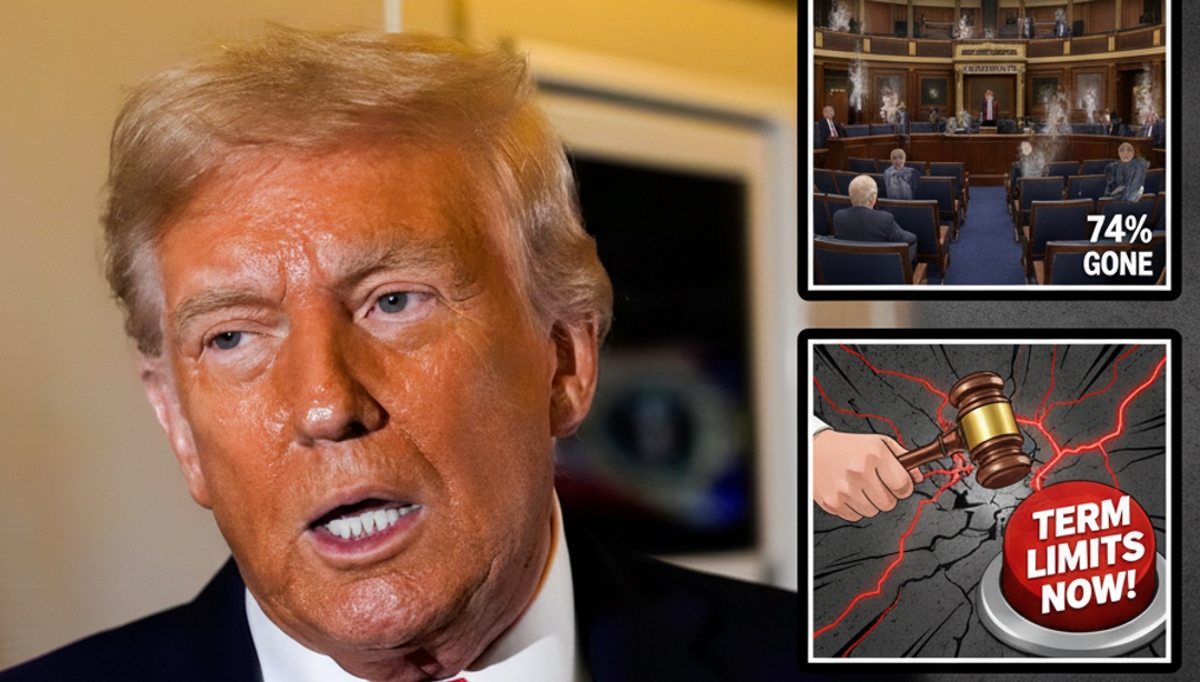
Donald Trump has once again detonated a political grenade in Washington, proposing strict term limits that would fundamentally remake Congress almost instantly. His plan would cap House members at six years and senators at twelve, a move analysts say would force out roughly 73 percent of sitting lawmakers in one sweeping reset.
The proposal landed at a moment of deep public frustration with Congress, where approval ratings have hovered near historic lows. Trump framed the idea as an assault on what he calls a “permanent political class,” language that mirrors arguments long circulated in recent polling showing widespread anger toward entrenched incumbents.
Under Trump’s outline, House members would be limited to three two-year terms, while senators would serve no more than two six-year terms. According to Congressional tallies, the change would immediately disqualify hundreds of veteran lawmakers whose seniority currently shapes budgets, committees, and national priorities.
Supporters argue that is precisely the point. They say decades-long careers in Washington have produced stagnation, corruption, and a disconnect from everyday Americans, a critique echoed in campaign finance analyses tracking how power concentrates around senior members.
Career politicians are the problem. Term limits would finally force accountability. — Charlie Kirk (@charliekirk11) Dec 2025
Critics counter that the numbers alone should trigger alarm. Removing nearly three-quarters of Congress at once would represent one of the largest institutional disruptions in American history, a scenario scholars warn about in governance research examining how experience affects legislative stability.
They argue that senior lawmakers carry institutional memory critical to navigating crises, from debt ceilings to foreign conflicts. Without it, power could shift even more heavily toward unelected actors, a risk outlined in legal commentary on unintended consequences.
Trump has pitched term limits before, but this version is notably more aggressive. Earlier proposals focused on longer caps, while the current plan would purge Congress almost immediately, a shift documented in campaign reporting tracking how his rhetoric has hardened.
This would hollow out Congress and hand more power to lobbyists and staff. — Rep. Jamie Raskin (@RepRaskin) Dec 2025
Lobbying experts warn that rapid turnover could make inexperienced lawmakers more dependent on outside interests for guidance. Studies summarized in ethics reviews suggest term-limited legislatures often see lobbyists gain influence rather than lose it.
Still, the political appeal is undeniable. Surveys consistently show strong bipartisan support for some form of term limits, even among voters who distrust Trump personally, a dynamic explored in long-running surveys measuring public appetite for reform.
Constitutional hurdles remain steep. Congressional term limits would almost certainly require a constitutional amendment, a process requiring overwhelming bipartisan support across states. Legal barriers are explained in amendment primers frequently cited by election lawyers.
Trump allies argue that political impossibility should not excuse inaction. They point to state-level term limits, arguing those experiments prove voters prefer rotation over permanence, claims often raised in state comparisons tracking legislative turnover.
Washington won’t reform itself. That’s why this scares them. — Kari Lake (@KariLake) Dec 2025
Opponents respond that Congress is not a state legislature and that national complexity demands experience. They warn that wiping out committee chairs and veteran negotiators could destabilize everything from defense funding to disaster relief, concerns raised in security analyses focused on continuity.
The proposal has also reignited debate about voter choice. Some critics argue term limits override democracy by preventing voters from reelecting representatives they support, a philosophical tension unpacked in constitutional debates over representation.
Yet Trump’s framing has proven politically potent. By attaching a concrete number — 73 percent — he transformed an abstract reform into a dramatic purge, a messaging tactic strategists note in communication breakdowns analyzing his appeal.
People are angry for a reason. Congress hasn’t earned lifetime tenure. — Matt Walsh (@MattWalshBlog) Dec 2025
Whether the plan advances or not, its impact is already visible. Lawmakers from both parties have been forced to publicly defend their longevity, while challengers are using the proposal as proof that Washington has grown too insulated from consequences.
Trump’s term limits push has turned frustration into a stark choice: preserve experience at the risk of entrenchment, or embrace upheaval that could permanently alter how Congress functions. With trust in institutions eroding, the question now confronting voters is whether disruption feels like reform — or recklessness.