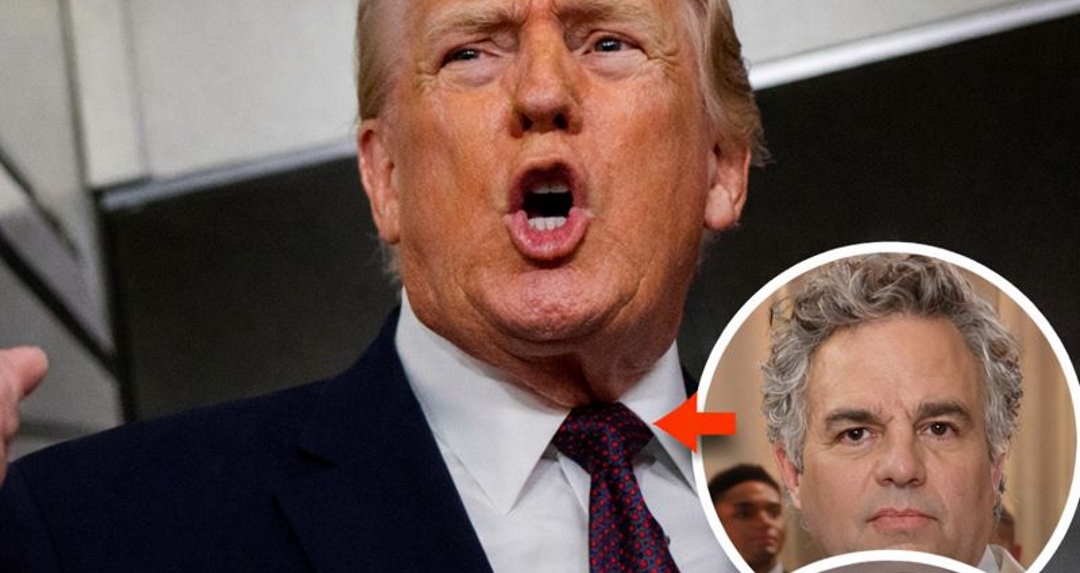
The image says everything before a word is spoken. Donald Trump mid-shout, fists clenched, framed beside Mark Ruffalo and J.D. Vance, each caught in moments of visible tension. It captures the collision that erupted this week — Hollywood outrage crashing straight into the center of American political power.
The flashpoint came after Mark Ruffalo unleashed a series of blistering accusations aimed at both Trump and Senator J.D. Vance, claiming their rhetoric and policy positions were actively fueling division, cruelty, and democratic backsliding. What followed was swift, sharp, and unmistakable: a full-throated response from the White House.
Administration officials dismissed Ruffalo’s remarks as “reckless celebrity grandstanding,” accusing the actor of spreading misinformation while exploiting his fame to inflame political tensions. One senior aide privately described the comments as “designed for applause, not facts,” echoing long-running debates over the role of celebrities in political discourse.
Ruffalo’s criticism focused heavily on immigration, economic populism, and what he called a “dangerous normalization of authoritarian language.” In a widely shared post, he accused Trump of “conditioning the country for cruelty” and labeled Vance as a willing amplifier of that worldview — rhetoric that immediately ricocheted across social media.
The White House response was unusually aggressive. Rather than ignoring the remarks, officials publicly pushed back, framing Ruffalo’s accusations as disconnected from policy reality and dismissive of voters who support Trump and Vance for economic or cultural reasons. The exchange revived a familiar cultural fault line explored in research on celebrity political influence.
Behind the scenes, aides suggested the decision to respond was strategic. Ruffalo’s comments weren’t just viral — they were gaining traction among younger voters and progressive activists, a dynamic the administration could not afford to leave unanswered.
Mark Ruffalo says what millions feel — but the White House isn’t letting Hollywood define the narrative this time. — CivicPulse (@CivicPulseNow) January 2026
Supporters of Ruffalo argue that dismissing him misses the point. They say his comments reflect genuine anxiety about the direction of the country and align with concerns raised by legal scholars, journalists, and watchdog groups — including warnings outlined in recent democratic integrity reports.
Trump allies, however, seized on the moment to accuse Hollywood elites of hypocrisy. Conservative commentators mocked Ruffalo’s moral authority, pointing to his wealth and insulation from the policies he criticizes — a familiar counterattack that mirrors longstanding conservative critiques of celebrity activism.
J.D. Vance, for his part, did not directly respond to Ruffalo but allies characterized the accusations as “hollow virtue signaling.” They argue that Vance’s appeal lies precisely in his rejection of cultural elites and that attacks from actors only reinforce his standing with working-class voters.
The episode highlights a deeper tension: who gets to shape the moral narrative of the country. Celebrities like Ruffalo bring visibility and emotional force, while political institutions claim legitimacy through elections and governance. When those worlds collide, the reaction is rarely quiet.
This isn’t about one actor — it’s about whether culture or power sets the boundaries of acceptable criticism. — MediaTheory (@MediaTheoryLab) January 2026
What makes this clash especially volatile is timing. With an election cycle looming and polarization already at a breaking point, every high-profile accusation becomes a test of narrative control. The White House’s decision to fire back signals that it views cultural influence as a real political force — not background noise.
Whether Ruffalo’s comments fade or continue to reverberate remains to be seen. But the image endures: a celebrity pointing fingers, a White House pushing back, and a political landscape where fame, power, and outrage are increasingly impossible to separate.